 A book shadowed me during a 2011 visit to Budapest.
I’ve written about my visits to the Terror House and the Holocaust Memorial, but I want to talk about what made it all even more memorable–the book I was reading at the same time.
Rick Steves‘ wonderful website has everything you need to visit Europe, including a section on recommended books. When I breezed through checking out the Budapest list, I saw Julie Orringer‘s The Invisible Bridge.
A story about Hungarian Jews prior to and through World War II, The Invisible Bridge had conflicting reviews on Amazon.com. I was willing to give it a chance until I read it was 600 pages long. Way too long, even for my little I-touch Kindle read.
But then a woman at the gym told me, “I couldn’t put The Invisible Bridge down. It came with me everywhere, I got so involved in the story.”
A little more manageable to tote on the I-touch Kindle ap, The Invisible Bridge escorted me through Budapest. It recounted the tale of a Jewish man caught up in events he couldn’t control and which not only weren’t fair, but didn’t make sense.
Grossly overwritten–It’s a 400 page novel crammed into 600 pages– it nevertheless echoed in my visit. It evoked lives from 70 years ago, overlaid on today’s Budapest. I’d recommend it for those seeking insight into the Jewish experience so long ago.
Meanwhile in Budapest
I stayed with and visited Budapest Jews who survived the war. The Invisible Bridge sent a resonance through almost every place I visited.
Here was the Jewish Ghetto where our hosts went to school, bullet holes from 1944 still visible in the walls. The main characters from The Invisible Bridge lived there, too.
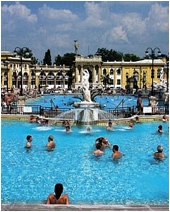
We spent a glorious afternoon floating in Széchenyi Baths where our hero visited as soon as he returned to Budapest after living in Paris.
We marveled at the Byzantine look of the Dohány Street Synagogue and that night I read about the hero and heroine’s wedding there.
I felt like I lived a parallel life: walking the streets and hearing the stories from locals during the day, and reading about the emotions (which our hosts did not want to discuss) through the novel at night.
Sometimes I got confused between the stories–but it all melded together into a sense of Budapest as a beautiful, well-loved city with a tragic past.
Books and travel can do that.
What books have you read that evoked strong emotions in places you’ve visited?
Tweetables
Visiting Budapest by day, reading about its past by night. Click to Tweet
The Invisible Bridge shadows a trip to Budapest Click to Tweet
A book makes a Budapest trip even more poignant. Click to Tweet


